Part 2: Inter-contract calls and testing
Previously, you learned how to create your first dApp. In this second session, you will enhance your skills on:
- How to do inter-contract calls.
- How to use views.
- How to do unit & mutation tests.
On the first version of the Poke game, you were able to poke any deployed contract. Now, you will add a new function to store on the trace an additional feedback message coming from another contract.
Poke and Get Feedback sequence diagram
Get the code
Get the code from the first session: https://github.com/marigold-dev/training-dapp-1/blob/main/solution
git clone https://github.com/marigold-dev/training-dapp-1.git
Reuse the code from the previous smart contract: https://github.com/marigold-dev/training-dapp-1/blob/main/solution/contracts/pokeGame.jsligo
Install all libraries locally:
cd solution && npm i && cd app && yarn install && cd ..
Modify the poke function
Change the storage to reflect the changes:
- If you poke directly, you must register the contract's owner's address and no feedback.
- If you poke and ask to get feedback from another contract, then you register the other contract address and an additional feedback message. Here is the new sequence diagram of the poke function.
-
Edit
./contracts/pokeGame.jsligoand replace the storage definition with this one:export type pokeMessage = {
receiver : address,
feedback : string
};
export type storage = {
pokeTraces : map<address, pokeMessage>,
feedback : string
}; -
Replace your poke function with these lines:
@entry
const poke = (_ : unit, store : storage) : return_ => {
    let feedbackMessage = {receiver : Tezos.get_self_address() ,feedback: ""};
    return [  list([]) as list<operation>, {...store,
        pokeTraces : Map.add(Tezos.get_source(), feedbackMessage, store.pokeTraces) }];
};
Explanation:
...storedo a copy by value of your object. Note: you cannot do an assignment like thisstore.pokeTraces=...in jsLIGO.Map.add(...: Add a key, value entry to a map. For more information about Map.export type storage = {...};aRecordtype is declared, it is an object structure known in LIGO as a Record.Tezos.get_self_address()is a native function that returns the current contract address running this code. Have a look at Tezos native functions.feedback: "": poking directly does not store feedback.
-
Edit
pokeGame.storageList.jsligoto change the storage initialization.#import "pokeGame.jsligo" "Contract"
const default_storage: Contract.storage = {
pokeTraces: Map.empty as map<address, Contract.pokeMessage>,
feedback: "kiss"
}; -
Compile your contract.
TAQ_LIGO_IMAGE=ligolang/ligo:1.6.0 taq compile pokeGame.jsligoWrite a second function
pokeAndGetFeedbackinvolving the call to another contract a bit later, let's do unit testing first!
Write unit tests
-
Add a new unit test smart-contract file
unit_pokeGame.jsligo.taq create contract unit_pokeGame.jsligoℹ️ Testing documentation can be found here
-
Edit the file.
#import "./pokeGame.jsligo" "PokeGame"

export type main_fn = module_contract<parameter_of PokeGame, PokeGame.storage>;

// reset state

const _ = Test.reset_state(2 as nat, list([]) as list<tez>);

const faucet = Test.nth_bootstrap_account(0);

const sender1: address = Test.nth_bootstrap_account(1);

const _2 = Test.log("Sender 1 has balance : ");

const _3 = Test.log(Test.get_balance_of_address(sender1));

const _4 = Test.set_baker(faucet);

const _5 = Test.set_source(faucet);

export const initial_storage = {
  pokeTraces: Map.empty as map<address, PokeGame.pokeMessage>,
  feedback: "kiss"
};

export const initial_tez = 0mutez;

//functions

export const _testPoke = (
  taddr: typed_address<parameter_of PokeGame, PokeGame.storage>,
  s: address
): unit => {
  const contr = Test.to_contract(taddr);
  const contrAddress = Tezos.address(contr);
  Test.log("contract deployed with values : ");
  Test.log(contr);
  Test.set_source(s);
  const status = Test.transfer_to_contract(contr, Poke(), 0 as tez);
  Test.log(status);
  const store: PokeGame.storage = Test.get_storage(taddr);
  Test.log(store);
  //check poke is registered

  match(Map.find_opt(s, store.pokeTraces)) {
    when (Some(pokeMessage)):
      do {
        assert_with_error(
          pokeMessage.feedback == "",
          "feedback " + pokeMessage.feedback + " is not equal to expected "
          + "(empty)"
        );
        assert_with_error(
          pokeMessage.receiver == contrAddress,
          "receiver is not equal"
        );
      }
    when (None()):
      assert_with_error(false, "don't find traces")
  };
};

// TESTS //

const testSender1Poke =
  (
    (): unit => {
      const orig =
        Test.originate(contract_of(PokeGame), initial_storage, initial_tez);
      _testPoke(orig.addr, sender1);
    }
  )();
Explanations:
#import "./pokeGame.jsligo" "PokeGame"to import the source file as a module to call functions and use object definitions.export type main_fnit will be useful later for the mutation tests to point to the main function to call/mutate.Test.reset_state ( 2...this creates two implicit accounts on the test environment.Test.nth_bootstrap_accountThis returns the nth account from the environment.Test.to_contract(taddr)andTezos.address(contr)are util functions to convert typed addresses, contract, and contract addresses.let _testPoke = (s : address) : unit => {...}declaring function starting with_is escaping the test for execution. Use this to factorize tests changing only the parameters of the function for different scenarios.Test.set_sourcedo not forget to set this value for the transaction signer.Test.transfer_to_contract(CONTRACT, PARAMS, TEZ_COST)A transaction to send, it returns an operation.Test.get_storageThis is how to retrieve the contract's storage.assert_with_error(CONDITION,MESSAGE)Use assertion for unit testing.const testSender1Poke = ...This test function will be part of the execution report.Test.originate_module(MODULE_CONVERTED_TO_CONTRACT,INIT_STORAGE, INIT_BALANCE)It originates a smart contract into the Test environment. A module is converted to a smart contract.
-
Run the test
TAQ_LIGO_IMAGE=ligolang/ligo:1.6.0 taq test unit_pokeGame.jsligoThe output should give you intermediary logs and finally the test results.
┌──────────────────────┬────────────────────────────────────────────────────────────────────────────────────────────────────────────────────────────────────────────────┐
│ Contract             │ Test Results                                                                                                                                   │
├──────────────────────┼────────────────────────────────────────────────────────────────────────────────────────────────────────────────────────────────────────────────┤
│ unit_pokeGame.jsligo │ "Sender 1 has balance : "                                                                                                                      │
│                      │ 3800000000000mutez                                                                                                                             │
│                      │ "contract deployed with values : "                                                                                                             │
│                      │ KT1KwMWUjU6jYyLCTWpZAtT634Vai7paUnRN(None)                                                                                                     │
│                      │ Success (2130n)                                                                                                                                │
│                      │ {feedback = "kiss" ; pokeTraces = [tz1TDZG4vFoA2xutZMYauUnS4HVucnAGQSpZ -> {feedback = "" ; receiver = KT1KwMWUjU6jYyLCTWpZAtT634Vai7paUnRN}]} │
│                      │ Everything at the top-level was executed.                                                                                                      │
│                      │ - testSender1Poke exited with value ().                                                                                                        │
│                      │                                                                                                                                                │
│                      │ 🎉 All tests passed 🎉                                                                                                                         │
└──────────────────────┴────────────────────────────────────────────────────────────────────────────────────────────────────────────────────────────────────────────────┘
Do an inter-contract call
To keep things simple, 2 versions of the same smart contract are deployed to simulate inter-contract calls and get the feedback message (cf. sequence diagram).
Create a new poke function PokeAndGetFeedback: (other : address) with a second part function PokeAndGetFeedbackCallback: (feedback : returned_feedback) as a callback. Calling a contract is asynchronous, this is the reason it is done two times.
The function to call on the second contract is GetFeedback: (contract_callback: oracle_param) and returns a feedback message.
Very often, this kind of contract is named an
Oracle, because generally its storage is updated by an offchain scheduler and it exposes data to any onchain smart contracts.
-
Edit the file
pokeGame.jsligo, to define new types:type returned_feedback = [address, string]; //address that gives feedback and a string message
type oracle_param = contract<returned_feedback>;Explanations :
type returned_feedback = [address, string]the parameters of an oracle function always start with the address of the contract caller and followed by the return objects.type oracle_param = contract<returned_feedback>the oracle parameters need to be wrapped inside a typed contract.
-
Write the missing functions, starting with
getFeedback. Add this new function at the end of the file.@entry
const getFeedback = (contract_callback : contract<returned_feedback>, store : storage): return_ => {
let op : operation = Tezos.transaction(
[Tezos.get_self_address(),store.feedback],
(0 as mutez),
contract_callback);
return [list([op]) ,store];
};Tezos.transaction(RETURNED_PARAMS,TEZ_COST,CALLBACK_CONTRACT)the oracle function requires to return the value back to the contract caller that is passed already as first parameter.return [list([op]) ,store]this time, you return a list of operations to execute, there is no need to update the contract storage (but it is a mandatory return object).
-
Add now, the first part of the function
pokeAndGetFeedback.@entry
const pokeAndGetFeedback = (oracleAddress: address, store: storage): return_ => {
//Prepares call to oracle
let call_to_oracle = (): contract<oracle_param> => {
return match(
Tezos.get_entrypoint_opt("%getFeedback", oracleAddress) as
option<contract<oracle_param>>
) {
when (None()):
failwith("NO_ORACLE_FOUND")
when (Some(contract)):
contract
};
};
// Builds transaction
let op: operation =
Tezos.transaction(
(
(
Tezos.self("%pokeAndGetFeedbackCallback") as
contract<returned_feedback>
)
),
(0 as mutez),
call_to_oracle()
);
return [list([op]), store];
};Tezos.get_entrypoint_opt("%getFeedback",oracleAddress)you require to get the oracle contract address. Then you want to call a specific entrypoint of this contract. The function name is always starting with%with always the first letter in lowercase (even if the code is different).Tezos.transaction(((Tezos.self("%pokeAndGetFeedbackCallback") as contract<returned_feedback>)),TEZ_COST,call_to_oracle())The transaction takes as first param the entrypoint of for the callback that the oracle uses to answer the feedback, the tez cost and the oracle contract you got just above as transaction destination.
-
Write the last missing function
pokeAndGetFeedbackCallback, receive the feedback and finally store it.@entry
const pokeAndGetFeedbackCallback = (feedback : returned_feedback, store : storage) : return_ => {
let feedbackMessage = {receiver : feedback[0] ,feedback: feedback[1]};
return [ list([]) as list<operation>, {...store,
pokeTraces : Map.add(Tezos.get_source(), feedbackMessage , store.pokeTraces) }];
};let feedbackMessage = {receiver : feedback[0] ,feedback: feedback[1]}prepares the trace including the feedback message and the feedback contract creator.{...store,pokeTraces : Map.add(Tezos.get_source(), feedbackMessage , store.pokeTraces) }add the new trace to the global trace map.
-
Compile the contract.
TAQ_LIGO_IMAGE=ligolang/ligo:1.6.0 taq compile pokeGame.jsligo -
(Optional) Write a unit test for this new function
pokeAndGetFeedback.
Use views instead of inter-contract call
As you saw in the previous step, inter-contract calls make the business logic more complex but not only that, thinking about the cost is even worse, as described in Optimisation in the LIGO documentation.
In this training, the oracle is providing a read-only storage that can be replaced by a view instead of a complex and costly callback.
See the documentation here about onchain views.
⚠️ Comment below functions (with /* */ syntax or // syntax) or just remove it, it is no more useful ⚠️
pokeAndGetFeedbackCallbackgetFeedback
-
Edit function
pokeAndGetFeedbackto call view instead of a transaction.@entry
const pokeAndGetFeedback = (oracleAddress: address, store: storage): return_ => {
//Read the feedback view
let feedbackOpt: option<string> =
Tezos.call_view("feedback", unit, oracleAddress);
match(feedbackOpt) {
when (Some(feedback)):
do {
let feedbackMessage = { receiver: oracleAddress, feedback: feedback };
return [
list([]) as list<operation>,
{
...store,
pokeTraces: Map.add(
Tezos.get_source(),
feedbackMessage,
store.pokeTraces
)
}
];
}
when (None()):
failwith("Cannot find view feedback on given oracle address")
};
}; -
Declare the view at the end of the file. Do not forget the annotation
@view!@view
export const feedback = (_: unit, store: storage): string => { return store.feedback }; -
Compile the contract.
TAQ_LIGO_IMAGE=ligolang/ligo:1.6.0 taq compile pokeGame.jsligo -
(Optional) Write a unit test for the updated function
pokeAndGetFeedback.
Write mutation tests
LIGO provides mutation testing through the Test library. Mutation tests are like testing your tests to see if your unit test coverage is strong enough. Bugs, or mutants, are automatically inserted into your code. Your tests are run on each mutant.
If your tests fail then the mutant is killed. If your tests passed, the mutant survived. The higher the percentage of mutants killed, the more effective your tests are.
Example of mutation features for other languages
-
Create a file
mutation_pokeGame.jsligo.taq create contract mutation_pokeGame.jsligo -
Edit the file.
#import "./pokeGame.jsligo" "PokeGame"

#import "./unit_pokeGame.jsligo" "PokeGameTest"

// reset state

const _ = Test.reset_state(2 as nat, list([]) as list<tez>);

const faucet = Test.nth_bootstrap_account(0);

const sender1: address = Test.nth_bootstrap_account(1);

const _1 = Test.log("Sender 1 has balance : ");

const _2 = Test.log(Test.get_balance_of_address(sender1));

const _3 = Test.set_baker(faucet);

const _4 = Test.set_source(faucet);

const _tests = (
  ta: typed_address<parameter_of PokeGame, PokeGame.storage>,
  _: michelson_contract<parameter_of PokeGame, PokeGame.storage>,
  _2: int
): unit => { return PokeGameTest._testPoke(ta, sender1); };

const test_mutation =
  (
    (): unit => {
      const mutationErrorList =
        Test.originate_and_mutate_all(
          contract_of(PokeGame),
          PokeGameTest.initial_storage,
          PokeGameTest.initial_tez,
          _tests
        );
      match(mutationErrorList) {
        when ([]):
          unit
        when ([head, ..._tail]):
          do {
            Test.log(head);
            Test.assert_with_error(false, Test.to_string(head[1]))
          }
      };
    }
  )();
Explanation:
#import <SRC_FILE> <NAMESPACE>: import your source code that will be mutated and your unit tests. For more information, see Namespaces in the LIGO documentation.const _tests = (ta: typed_address<parameter_of PokeGame, PokeGame.storage>, _: michelson_contract, _: int) : unit => {...: you need to provide the test suite that will be run by the framework. Just point to the unit test you want to run.const test_mutation = (() : unit => {: this is the definition of the mutations tests.Test.originate_module_and_mutate_all(CONTRACT_TO_MUTATE, INIT_STORAGE, INIT_TEZ_COST, UNIT_TEST_TO_RUN): This will take the first argument as the source code to mutate and the last argument as unit test suite function to run over. It returns a list of mutations that succeed (if size > 0 then bad test coverage) or an empty list (good, even mutants did not harm your code).
-
Run the test.
TAQ_LIGO_IMAGE=ligolang/ligo:1.6.0 taq test mutation_pokeGame.jsligoOutput:
=== Error messages for mutation_pokeGame.jsligo ===
File "contracts/mutation_pokeGame.jsligo", line 43, characters 12-66:
42 |             Test.log(head);
43 |             Test.assert_with_error(false, Test.to_string(head[1]))
44 |           }

Test failed with "Mutation at: File "contracts/pokeGame.jsligo", line 52, characters 15-66:
51 |     when (None()):
52 |       failwith("Cannot find view feedback on given oracle address")
53 |   };

Replacing by: "Cannot find view feedback on given oracle addressCannot find view feedback on given oracle address".
"
Trace:
File "contracts/mutation_pokeGame.jsligo", line 43, characters 12-66 ,
File "contracts/mutation_pokeGame.jsligo", line 43, characters 12-66 ,
File "contracts/mutation_pokeGame.jsligo", line 28, character 2 to line 47, character 5


===
┌──────────────────────────┬──────────────────────┐
│ Contract                 │ Test Results         │
├──────────────────────────┼──────────────────────┤
│ mutation_pokeGame.jsligo │ Some tests failed :( │
└──────────────────────────┴──────────────────────┘
Invaders are here.
What happened?
The mutation has altered a part of the code that is not tested, it was not covered, so the unit test passed.
For a short fix, tell the Library to ignore this function for mutants.
-
Go to your source file pokeGame.jsligo, and annotate the function
pokeAndGetFeedbackwith@no_mutation.@no_mutation
@entry
const pokeAndGetFeedback ... -
Run again the mutation tests.
TAQ_LIGO_IMAGE=ligolang/ligo:1.6.0 taq test mutation_pokeGame.jsligoOutput
┌──────────────────────────┬────────────────────────────────────────────────────────────────────────────────────────────────────────────────────────────────────────────────┐
│ Contract                 │ Test Results                                                                                                                                   │
├──────────────────────────┼────────────────────────────────────────────────────────────────────────────────────────────────────────────────────────────────────────────────┤
│ mutation_pokeGame.jsligo │ "Sender 1 has balance : "                                                                                                                      │
│                          │ 3800000000000mutez                                                                                                                             │
│                          │ "contract deployed with values : "                                                                                                             │
│                          │ KT1L8mCbuTJXKq3CDoHDxqfH5aj5sEgAdx9C(None)                                                                                                     │
│                          │ Success (1330n)                                                                                                                                │
│                          │ {feedback = "kiss" ; pokeTraces = [tz1hkMbkLPkvhxyqsQoBoLPqb1mruSzZx3zy -> {feedback = "" ; receiver = KT1L8mCbuTJXKq3CDoHDxqfH5aj5sEgAdx9C}]} │
│                          │ "Sender 1 has balance : "                                                                                                                      │
│                          │ 3800000000000mutez                                                                                                                             │
│                          │ Everything at the top-level was executed.                                                                                                      │
│                          │ - test_mutation exited with value ().                                                                                                          │
│                          │                                                                                                                                                │
│                          │ 🎉 All tests passed 🎉                                                                                                                         │
└──────────────────────────┴────────────────────────────────────────────────────────────────────────────────────────────────────────────────────────────────────────────────┘
Update the frontend
-
Reuse the dApp files from the previous session.
-
Redeploy a new version of the smart contract.
Note: You can set
feedbackvalue to any action other than defaultkissstring (it is more fun for other to discover it).TAQ_LIGO_IMAGE=ligolang/ligo:1.6.0 taq compile pokeGame.jsligo
taq generate types ./app/src
taq deploy pokeGame.tz -e "testing" -
Adapt the frontend application code. Edit
App.tsx, and add new import.import { address } from './type-aliases'; -
Add a new React variable after
userBalancedefinition.const [contractToPoke, setContractToPoke] = useState<string>(''); -
Change the poke function to set entrypoint to
pokeAndGetFeedback.//poke
const poke = async (
e: React.FormEvent<HTMLFormElement>,
contract: api.Contract
) => {
e.preventDefault();
let c: PokeGameWalletType = await Tezos.wallet.at('' + contract.address);
try {
const op = await c.methodsObject
.pokeAndGetFeedback(contractToPoke as address)
.send();
await op.confirmation();
alert('Tx done');
} catch (error: any) {
console.log(error);
console.table(`Error: ${JSON.stringify(error, null, 2)}`);
}
}; -
Change the display to a table changing
contracts.map...by:<table><thead><tr><th>address</th><th>trace "contract - feedback - user"</th><th>action</th></tr></thead><tbody>
{contracts.map((contract) => <tr><td style={{borderStyle: "dotted"}}>{contract.address}</td><td style={{borderStyle: "dotted"}}>{(contract.storage !== null && contract.storage.pokeTraces !== null && Object.entries(contract.storage.pokeTraces).length > 0)?Object.keys(contract.storage.pokeTraces).map((k : string)=>contract.storage.pokeTraces[k].receiver+" "+contract.storage.pokeTraces[k].feedback+" "+k+", "):""}</td><td style={{borderStyle: "dotted"}}><form onSubmit={(e) =>poke(e,contract)}><input type="text" onChange={e=>setContractToPoke(e.currentTarget.value)} placeholder='enter contract address here' /><button type='submit'>Poke</button></form></td></tr>)}
</tbody></table> -
Relaunch the app.
cd app
yarn install
yarn dev
On the listed contract, choose your line and input the address of the contract you will receive feedback. Click on
poke.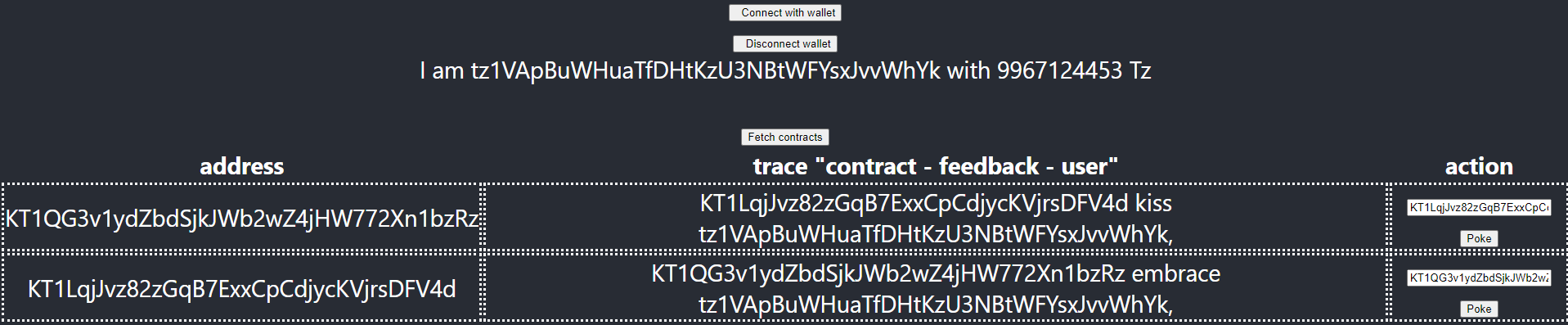 .
.This time, the logged user will receive feedback from a targeted contract (as input of the form) via any listed contract (the first column of the table). Refresh manually by clicking on
Fetchcontracts` button.Poke other developers' contracts to discover their contract hidden feedback when you poke them.
Summary
Now, you can call other contracts, use views, and test your smart contract before deploying it. In the next training, you will learn how to use tickets.
When you are ready, continue to Part 3: Tickets.